
Written by: John Wannamaker
When people talk about the failure of plastic recycling, the explanation often sounds simple: corporations are greedy, the system is broken, or no one is trying hard enough. But the real reason plastic recycling struggles has less to do with evil intent — and more to do with geology.
Plastic recycling can’t compete with brand-new plastic because the raw ingredients for new plastic are basically free. Not metaphorically free. Geologically free.
The Real Problem: Virgin Plastic Is Dirt Cheap
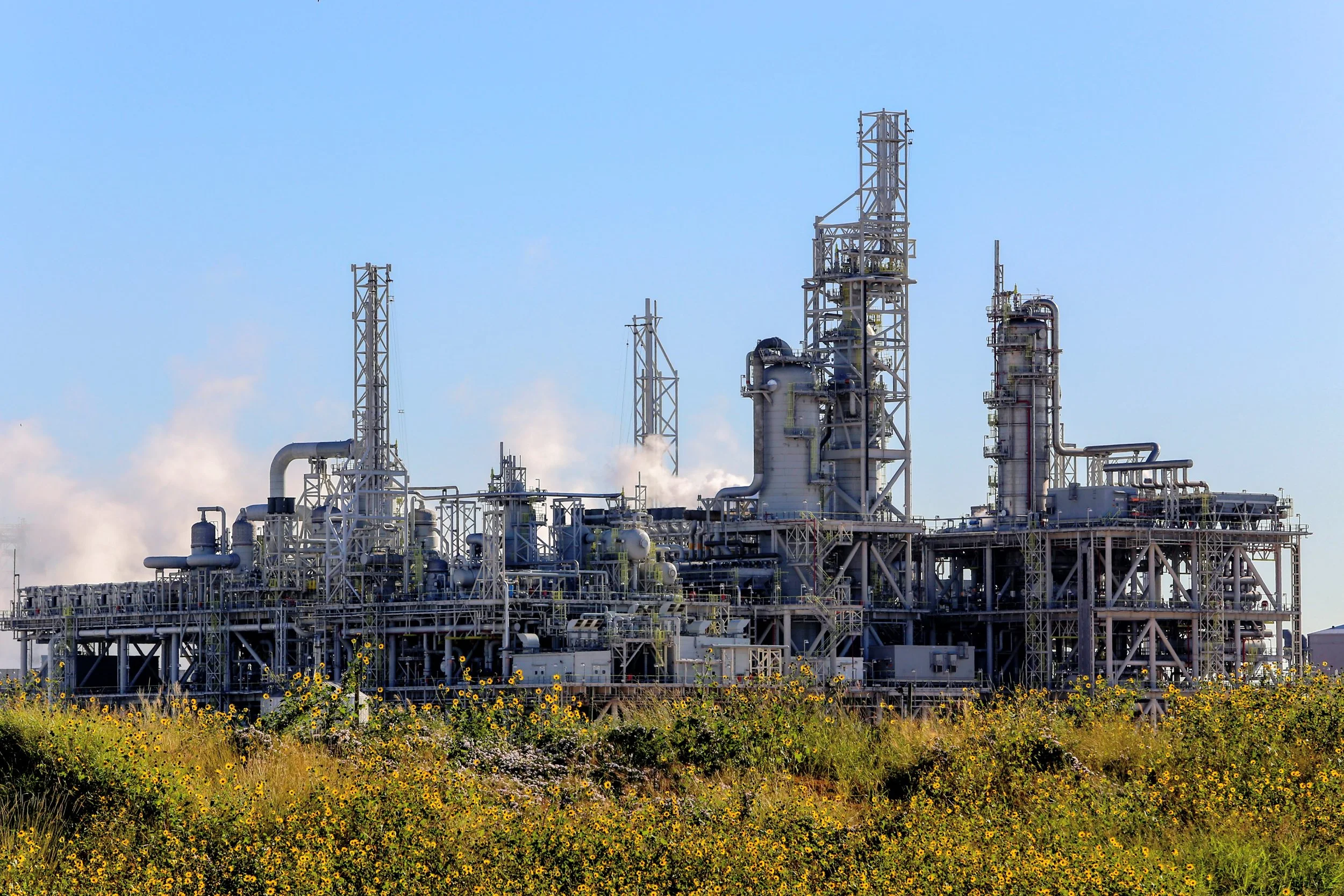
The plastics plant in Gregory, Texas, operated by ExxonMobil and the Saudi Basic Industries Corporation started operations in 2022. Credit: Dylan Baddour/Inside Climate News
On the Gulf Coast of Texas, massive petrochemical plants turn ethane, a byproduct of natural gas extraction, into the building blocks of plastic. And ethane is astonishingly cheap. In some cases, companies can buy the equivalent of a barrel for just a few dollars.
That low price creates a chain reaction:
Cheap ethane → Cheap ethylene → Cheap polyethylene and PET → Extremely cheap virgin plastic
Meanwhile, recycled plastic pellets often cost twice as much as new ones.
Meet Ethane: The “Free” Ingredient
Most single-use plastics begin as ethane. But here’s the twist: No one is drilling for ethane.
Energy companies drill for methane (natural gas), which we burn for electricity, heating, and cooking. Ethane just happens to come up with it, especially from shale formations unlocked by fracking. And companies can’t choose to extract methane without also extracting ethane. It’s chemically bundled together underground. That creates a huge oversupply of ethane.
If companies can’t sell it:
They can’t always send it down pipelines (limits exist).
They can’t flare unlimited amounts (regulations restrict it).
And if they don’t offload it, they may have to shut down the well.
So petrochemical companies happily buy this ultra-cheap ethane and turn it into plastic. The result? A flood of inexpensive virgin plastic entering global markets.
Why Recycling Is More Expensive
Even without the ethane problem, recycling has challenges:
Plastics degrade when reheated.
Different plastic types are hard to separate.
Labels, caps, dyes, glue, and food contamination complicate processing.
Sorting is labor-intensive and costly.
Recycled plastic must be cleaned to food-grade standards.
In contrast, virgin plastic starts out pure and uniform. Even perfect recycling technology would still be competing with feedstock that’s effectively treated as waste from gas drilling.
Is There Any Hope?
Despite the discouraging economics, there are glimmers of possibility.
Chemical Recycling Innovations
New technologies aim to break plastics down into their original chemical components rather than just melting them.
Examples include:
Nickel-catalyst systems that break down difficult plastics like polypropylene.
Plasma torch systems that can convert mixed, dirty plastic into base chemicals without sorting.
Enzymatic recycling (like Carbios in France) that uses engineered enzymes to break PET back into its building blocks.
Some of these approaches could create true “closed-loop” recycling, where old plastic becomes new plastic of the same quality.
The big question? Energy use and cost.
The Role of Policy
Technology alone may not be enough.France, for example, is supporting recycled plastics through government funding and financial incentives for manufacturers who use recycled materials. Similar policy support helped solar power go from expensive niche technology to the cheapest electricity source in history.
Could plastics follow the same trajectory? Possibly, but it would require political will and sustained investment.
The Energy Paradox
Here’s the uncomfortable truth:
Plastic is cheap because natural gas is cheap.
Natural gas is cheap because of the shale boom.
And we rely heavily on natural gas for electricity.
Unless we reduce methane extraction — by scaling renewables, nuclear, geothermal, and other energy sources — ethane will continue flooding the market. Which means virgin plastic will stay cheap.
Recycling doesn’t just compete with petrochemicals. It competes with the entire energy system.
Reasons for Optimism
Despite everything, progress is real:
Solar and battery prices have dropped dramatically.
Recycling technologies are improving.
Enzyme-based and chemical recycling methods show promise.
Some decentralized systems even allow local plastic reuse.
Technologies that seem unrealistic today could be commonplace in 10–20 years. We’ve seen that story before.
The Big Takeaway
Plastic recycling isn’t failing because no one cares. It’s failing because virgin plastic is artificially cheap due to oversupplied fossil fuel byproducts.
To make recycling competitive, one or more of the following must happen:
Virgin plastic becomes more expensive
Recycling becomes dramatically cheaper
Governments level the playing field
Or society uses less plastic overall
Most likely, it will take a mix of all four. Until then, we’re stuck in a strange world where fossil fuel byproducts are so cheap that making new plastic costs less than reusing the old stuff.
And that’s not just a recycling problem. It’s an energy problem.